Explainable Forensic Face Recognition (EFFR) Based on FISWG Features
You can read the full paper here: Download PDF (Explainable Forensic Face Recognition based on FISWG Features.pdf)
Introduction
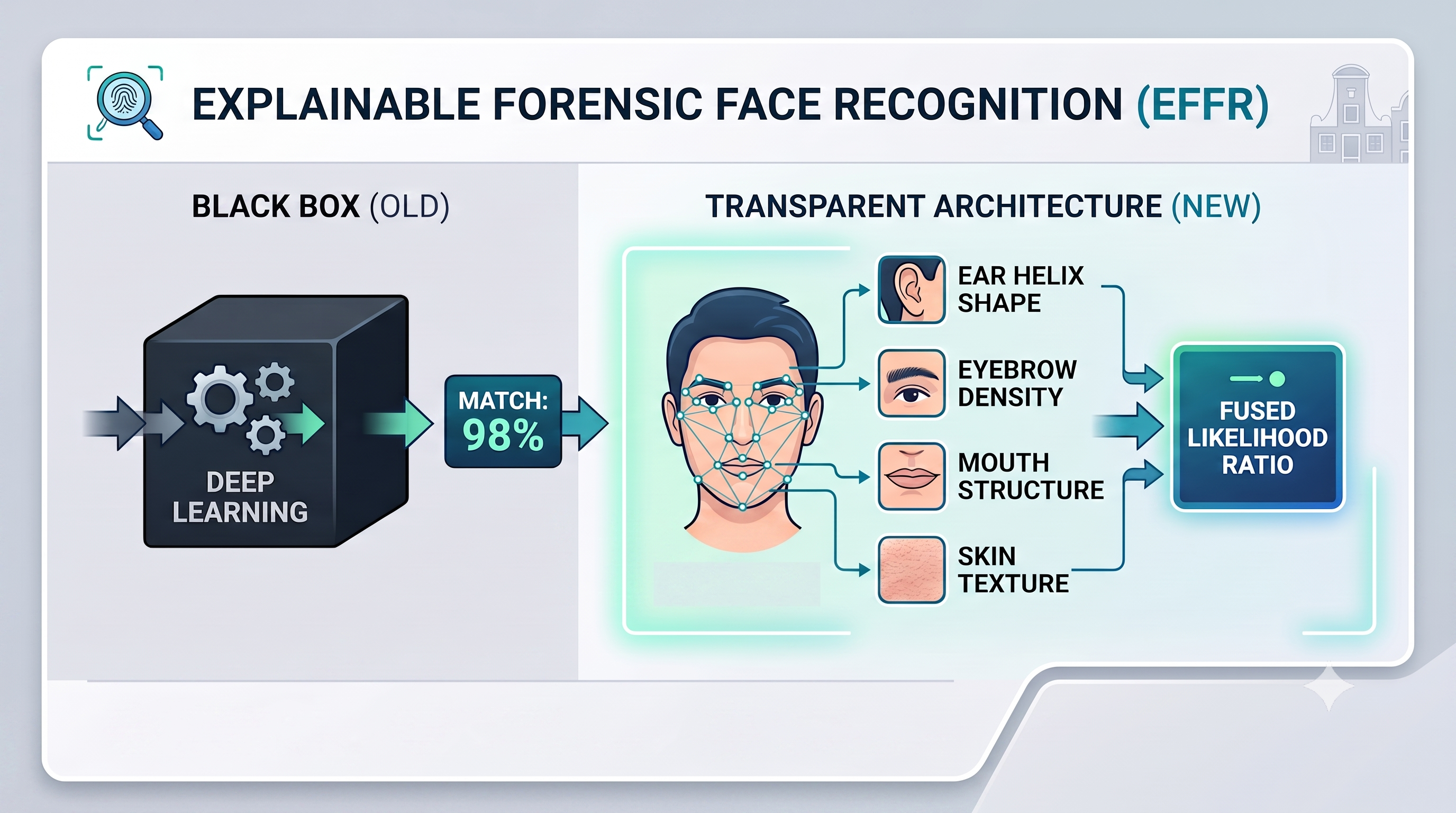
Developed an Explainable Forensic Face Recognition (EFFR) model, an innovative "explainable-by-design" biometric system tailored for forensic and legal use. Moving away from traditional deep learning black-box systems, the architecture incorporates international Facial Identification Scientific Working Group (FISWG) guidelines to break facial data into human-verifiable features. By combining deep learning with classical computer vision, the model translates complex feature comparisons into Likelihood Ratios (LR) to demonstrate statistical evidence strength.
Project Details
- Core Tech: Python, OpenCV, NumPy, PyTorch, Scikit-Learn.
- AI Components: HRNet (High-Resolution Network for landmarks), BiSeNet (Bilateral Segmentation Network), YOLOv11M (Object detection for facial marks).
- Classical Computer Vision: Fourier Shape Descriptors (FSD), Local Binary Patterns (LBP), Gray-Level Co-occurrence Matrix (GLCM), Haralick Features.
- Machine Learning: Logistic Regression, Isolation Forest (Anomaly Detection), Agglomerative Clustering.
- Forensic: Score-based Likelihood Ratios (SLR),
- Dataset: PUT Face Database (10,000 images, 100 subjects).
The Challenge
- The Black-Box: State-of-the-art face recognition models produce complex high-dimensional embeddings that are unintelligible to human juries and forensic examiners.
- Failure of Post-Hoc Explanations: Retroactive approach tools like Class Activation Mapping (CAM) or LIME produce simple heatmaps that show what pixels a model evaluated but fail to explain why a biometric decision was reached.
- Translating Human Linguistics to quantitative features: Mapping highly qualitative FISWG descriptions (such as ear helix curvatures or eyebrow shapes) into precise, reproducible quantitative data structures.
Key Features
- Hybrid AI/Classical Architecture: Utilized deep learning (HRNet & BiSeNet) for high-precision semantic segmentation and landmark detection, passing those pixel-level outputs into deterministic classical vision pipelines.
- Anatomical Feature Extractions:
- Ears: Extracted the ear region via face parsing, detected localized points, and mathematically mapped the curvature using second-degree polynomial and root-mean-square angular transitions.
- Eyebrows: Segmented rows into 4 quadrants, deploying a uniform rotation-invariant LBP histogram to differentiate edge/corner bins (representing individual hairs) from flat states (skin) to map density distributions.
- Mouth & Lips: Fitted Fourier Shape Descriptors across 4 boundaries to capture lip shapes.
- Skin: Isolated valid regions via erosion, choosing 50 random patches to evaluate micro-textures through multi-radius LBP and GLCM matrices.
- Facial Mark Tracking (YOLOv11M): Trained a middleweight object detection model on high-resolution images to detect anomalies like moles or freckles. Used perspective-n-point pose computation (solvePnP) to map 2D image coordinates onto a 3D cylindrical head model to track spatial distances.
- Hierarchical Statistical Fusing: Standardized raw comparison features via a Yeo-Johnson power transform, training a Logistic Regression model over normalized inputs to synthesize features into higher-level units.
- Multiplied Likelihood Ratios: Transformed scores into forensic Likelihood Ratios based on dataset-wide non-match/match densities to generate a final verification score.
Results
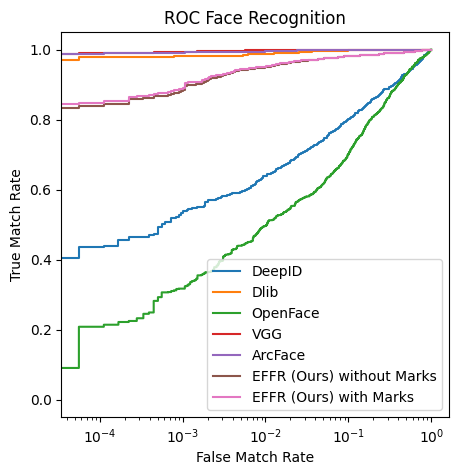
- Performance: Achieved an Equal Error Rate (EER) of 3.0% (and 4.2% on broader unconstrained settings), outperforming old deep learning models like OpenFace ($19.36%$ EER) and DeepID ($16.08%$ EER).
- Forensic Reporting Engine: Built a fully transparent report generator that make machine logic interpretable to a layperson jury.