Shapley Value-Driven Optimization of Gabor Filters for Iris Recognition
You can read the full paper here: Download PDF (Iris.pdf)
Introduction
Developed an advanced biometric iris recognition system that uses cooperative game theory to optimize John Daugman’s traditional feature extraction pipeline. By applying Shapley value-based feature importance, the system mathematically evaluates the individual contribution of 2D Gabor filters to eliminate redundancy. This data-driven approach yields a highly compressed, computationally efficient, and state-of-the-art filter set that achieves an Equal Error Rate (EER) as low as 0.05%.
Project Details
- Core Tech: Python, OpenCV, NumPy, Shapley Value Optimization, USIT SDK.
- Algorithms Used: 2D Complex Gabor Filters, Hamming Distance with Binary Masking.
- Target Datasets: CASIA-IrisV1, IrisV3, and MMU.
- My Role: Solo Researcher & Computer Vision Engineer.
The Challenge
- Proprietary & Lack of Transparency: John Daugman’s classic iris code remains the industry benchmark, but the specific optimal configuration of Gabor filters used in modern commercial systems is proprietary and unpublished.
- Combinatorial Search Space: Manually finding the optimal parameters (envelope size, wave orientation, wavelength, and strides) across different Gabor filter combinations creates an exponentially complex search space.
- Extreme Alignment Sensitivity: Minor rotational misalignments or vertical offsets (introduced during imperfect eye segmentation) cause dramatic, false mismatches.
Key Features & Actions
- Easy to use Library: Packaged the entire pipeline into an intuitive, clean, and easy to understand Python library, allowing other students to run end-to-end iris encoding and matching with just a few lines of code.
- Cooperative Game Theory Integration: Modeled Gabor filters as "players" in a cooperative game, calculating their marginal contribution (Shapley values) to systematically keep high-impact filters and prune redundant ones.
- Robust Rotational Alignment: Developed a dynamic pixel-shifting correction system on the normalized iris band to simulate and find the optimal matching rotation angle.
Results
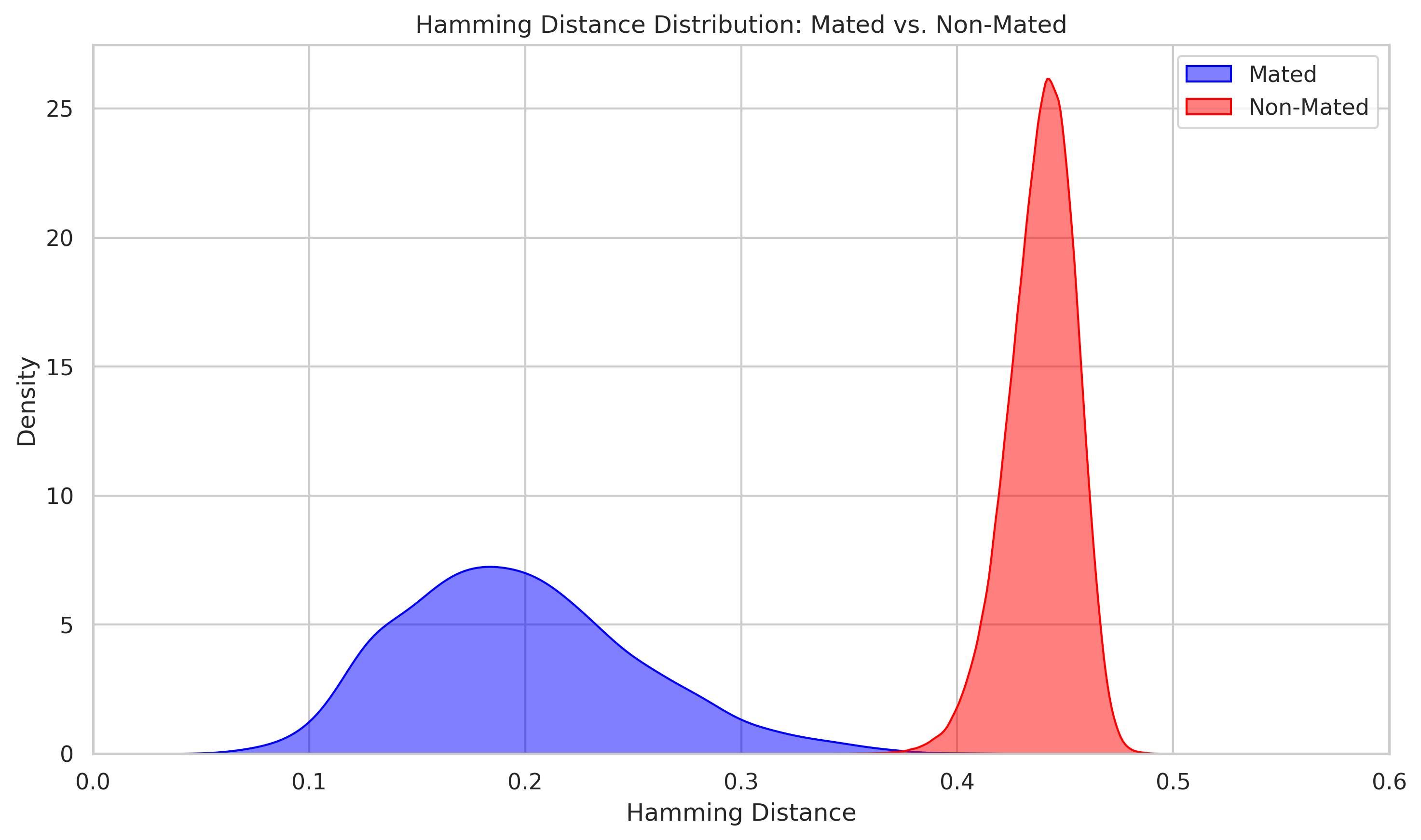
- State-of-the-Art Accuracy: Achieved an outstanding Equal Error Rate (EER) of 0.05% on the CASIA-IrisV1 dataset, outperforming the benchmark Kong et al. IrisCode implementation.
- Outperformed Deep Learning Methods: Reached an EER of 0.67% on the IrisV3 dataset, surpassing the benchmark Deep CNN approach (0.76% EER) and all standard algorithms in the USIT SDK.